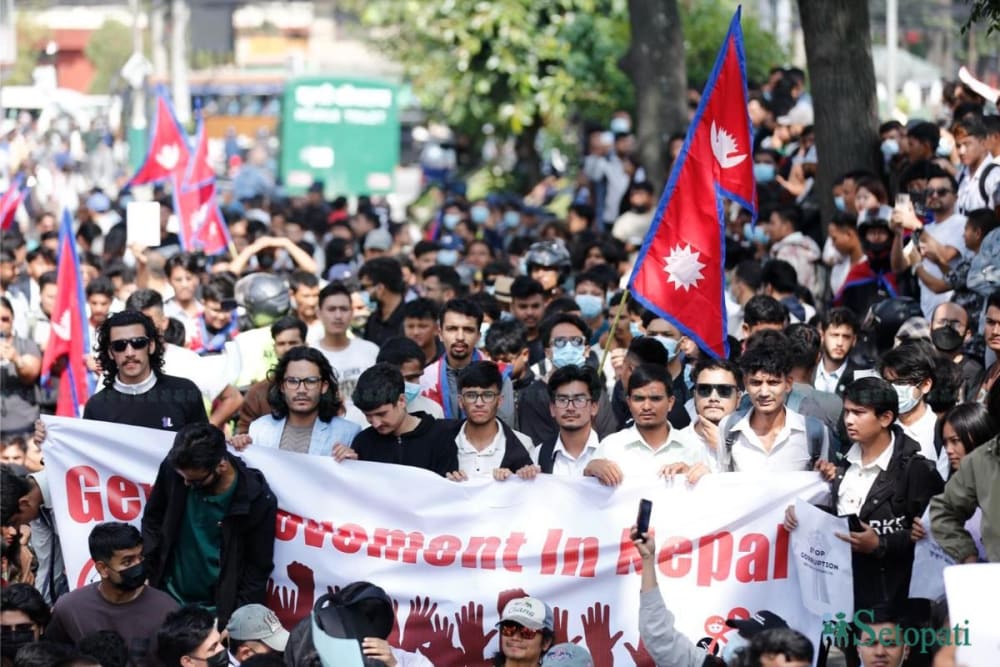
In September 2025, the Himalayan nation of Nepal witnessed a dramatic upheaval — a groundswell of protests driven largely by its youngest generation. Sparked by a sudden nationwide ban on major social-media platforms, the movement rapidly evolved into a broad uprising against corruption, nepotism, and political stagnation. These events reflect not just a momentary flashpoint but a potential turning point for Nepal’s political and digital future.
What happened?
- On 4 September 2025, the Nepalese government announced the suspension of 26 social-media platforms (including Facebook, Instagram, X (formerly Twitter) and others), citing non-compliance with new registration rules.
- The ban triggered living-room resentment among young people, rapidly spilling into the streets of the capital, Kathmandu, and beyond. On 8–9 September large crowds of students and young activists marched, many demanding transparency, accountability, and the lifting of the block — what’s been called the “Gen Z revolt.”
- The protests escalated: government offices, police stations and the parliament complex were set ablaze, thousands of prisoners escaped, and the military was deployed. The government soon revoked the ban, and by 12 September an interim government headed by former Chief Justice Sushila Karki was installed.
Why did it happen?
The social-media ban was the spark, but the tinder had long been burning:
- Youth unemployment in Nepal remains very high, economic prospects for many young Nepalis are limited.
- Political instability: Nepal has seen frequent changes in government, weak institutions, and widespread perceptions of corruption and nepotism.
- The ban itself symbolised a deeper frustration: Many young people viewed it as an attempt to silence dissent and restrict their digital freedoms.
- Social media and digital platforms allowed rapid mobilisation, communications and visibility for the movement of young people.
What does it mean?
- Digital power shift: The uprising showed that in Nepal, the digital generation can quickly wield influence. The use of gaming chat apps (e.g., Discord) to coordinate and even “choose” leadership (via online consultation) was novel.
- Political reset? With a new interim government, led for the first time by a woman Prime Minister (Sushila Karki), questions remain: Will this be a meaningful reform or simply a change of faces?
- Free speech & governance: The protests raised broader questions about the relationship between state power, youth & technology, and democratic freedoms in a digitally-connected world.
- Regional ripple effects: They form part of a wider wave of “Gen Z protests” across Asia and beyond, where younger generations are asserting digital and street influence.
What’s next?
- The interim government must deliver: manage the aftermath of violence, rebuild trust, ensure fair elections and restore citizen confidence.
- Reforms in governance, transparency and youth employment will likely dominate the agenda if the momentum is to be sustained.
- Digital policy will be under new scrutiny: how the government interacts with social platforms, regulates them, and protects online freedoms will be watched closely.
- The youth and civil-society actors will be key: their ability to remain organised, articulate a long-term vision and avoid disillusionment will determine if this moment becomes a lasting shift or a fleeting flare.
Final thought
Nepal’s September 2025 protests were more than just a social-media ban turned violent. They were a statement: a generation unwilling to be boxed out of digital life, political power and economic possibility. For a country that has wrestled with instability, the question is whether this moment becomes a pivot or remains an echo. For young Nepalis, the screen and the streets have fused — and they’re asking: what’s really next?